




















In The Devil Wears Prada 2, the question is no longer whether Miranda Priestly is the devil or the savior, but what kind of light can still function as salvation within a system that has already accepted its own twilight.
Christian orthodoxy clearly separates Christ and Satan. They are not the same being, nor two masks of a single figure. But within the Western tradition itself, a tension appears that exceeds that division. In The Marriage of Heaven and Hell, William Blake writes that without contraries there is no progression, then pushes the thought further by claiming that energy is eternal delight. In Aion, Carl Gustav Jung translates that line into psychological terms. The symbol of Christ cannot achieve wholeness without its dark side. Perfection excludes the shadow, while wholeness must contain it.
The Devil and the Savior are therefore not morally interchangeable, but neither are they fully separable on the level of being. Light that seeks to remain pure produces its own shadow, and every order that seeks salvation eventually gives rise to its own accuser.
The oldest biblical layer reveals that structure even more clearly. In the Books of Job and Zechariah, ha-satan is not yet the absolute enemy of God, but an accuser, an adversary, almost a celestial prosecutor. His function is not destruction but testing. He probes integrity, exposes fractures, looks for proof. He does not stand outside the order, but exists within it as one of its instruments.
Seen through that lens, Miranda moves beyond the simplified image of the devil. Her role is not domination but testing. She recognizes betrayal before the others because that is precisely what she does, exposing what people are made of once certainty disappears.
In that context, Lucifer also ceases to be a folkloric figure and returns to the meaning embedded in the name itself. He is the morning star, the bearer of light. A figure tied from the beginning to elevation, but also to the risk of falling. Within the structure of language itself, the devil is not the opposite of light, but its fractured form.
That fracture is visible within biblical symbolism itself. In Isaiah, the “morning star” falls, while in Revelation Christ is called the “bright Morning Star.” The same figure of light appears at both poles. This is not identity but tension. Light can reveal, but it can also seduce. It can guide, but it can also blind.
Within that space, Miranda finds her precise position. She is not darkness, but a demanding and dangerous form of light inside a system that no longer needs bearers, only distribution. For her, aesthetics are not a product but a criterion, a form through which truth can still be distinguished from simulation.
That is why her position within the system appears “devilish.” Not because she destroys, but because she still insists on the difference between creation and its replacement.
In a world where that distinction is dissolving, the figure still capable of naming it inevitably becomes an anomaly.
And it is precisely from that anomaly that her ability emerges to recognize betrayal where it no longer exists as an event, but as a condition.
Miranda can no longer be read simply as the devil, but as the ha-satan of late capitalism. Not a sovereign of darkness, but an accuser still probing what other people’s integrity is actually made of. In that sense, she stands closer to Job’s adversary than to the Hollywood demon. She tempts, exposes, and measures fractures.
It is precisely there that the connection between the Devil and the Savior begins to open. They remain separate, yet bound to one another. Both seek the truth about the human being, but not through the same path. One seeks it through accusation, the other through sacrifice. Blake’s idea that there is no progression without contraries, and Jung’s claim that perfection collapses wherever it rejects its own shadow, do not appear here as theory, but as structure.
Miranda is therefore not the moral opposite of salvation, but its dark companion. The face of a system that still remembers that vision cannot exist without a price.
Hierarchy of Devils and Soft Censorship
The original film was the geometry of a throne. The sequel introduces the geometry of a system The original Runway revolved around Miranda’s cold white chamber of power, while the sequel expands that space into open work zones where people no longer gather around authority, but around screens. Instead of bodies orbiting a single figure, a flow of content, metrics, and visibility begins to take shape Presence is gradually replaced by function.
Within that shift, Miranda ceases to be the only devil, and perhaps no longer the most dangerous one. The film unfolds as a story of media collapse in which Runway survives in a digitized and fragmented form, dependent on advertisers and the logic of social platforms. The new owner is not trying to save the magazine, but to translate it into a system where artificial intelligence takes over the role of editor, model, and mediator between image and audience. That space has already been described as a soulless media landscape, a hybrid of content and advertising form that no longer distinguishes creation from distribution.
Within that space, a clear hierarchy of devils begins to emerge.
Miranda Priestly functions as one of the last representatives of an older order. Her cruelty remains tied to judgment, to the ability to distinguish between creation and its replacement. The line “You’re not a visionary, you’re a vendor” does not land as a personal insult, but as a verdict separating two different logics. Vision implies a relationship to form, while the vendor sees the world as a sequence of objects to be distributed. When Miranda ultimately approves the $350,000 book deal and admits that such a choice carries consequences, she does not step outside the system, but names it for what it is. That is where her tragic dimension emerges. She remains bound to an order whose mechanisms she understands completely, yet can no longer change.
Emily Charlton occupies the second tier, not as absolute evil, but as a form of movement within that order. Her line, “May the bridges I burn light my way,” defines a logic in which light is produced through the severing of relationships. It does not emerge from a source, but from a process of elimination. In that sense, her ascent cannot be separated from loss, but depends on it. Every relationship she removes becomes part of the structure that allows her to move forward, while simultaneously closing the possibility of return. Her position therefore does not function simply as betrayal, but as a precise form of the contemporary career, illuminating its own trajectory through ruins.
The third tier of devils appears without an individual face. Technological investors, managerial structures, advertising logic, and digital infrastructure do not operate through grand gestures, but through procedure. Their power lies not in imposition, but in filtration. They do not shape content directly, but determine what will remain visible, what will be suppressed, and what will disappear without explicit prohibition. Algorithmic logic optimizes engagement, redistributes attention, and gradually removes elements that do not align with the required parameters.
Within that context, what emerges is a form of soft censorship. It does not operate through prohibition, but through the reduction of reach, through gradual silencing. Speech remains formally present, yet loses its effect. Such a mechanism does not require open conflict because the transformation takes place within the system of distribution itself.
The distinction between those layers then becomes clear. Miranda’s cruelty still presupposes relationship and responsibility, while systemic cruelty operates through neutrality and the absence of any visible author. What once appeared as a personal act now appears as technical necessity.
Within such a framework, the devil is no longer tied to the individual, but to the way the system itself is organized. Its force no longer reveals itself through direct confrontation, but through the gradual replacement of relationship with function, and presence with protocol.
Light-Bearer in the Cathedral of Capital
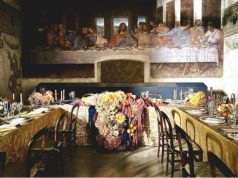
The Milan section of the film is not constructed as a luxury postcard, but as a semantic machine. The narrative moves through Milan as if through a second body, passing through the Accademia di Brera, the courtyard of Santa Maria delle Grazie, the reconstruction of The Last Supper, and, most importantly, the Galleria Vittorio Emanuele II. It is there that Miranda is given a rare moment of solitude, though that solitude does not function as relief, but as diagnosis. The sovereign is no longer surrounded by a court, but by the echo of her own presence.
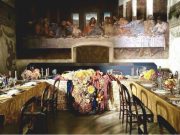
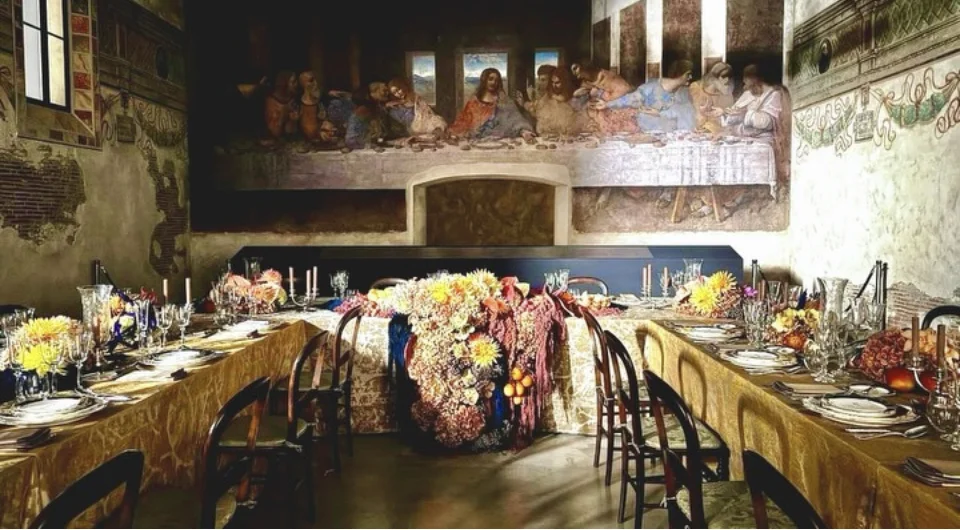
The production fact that The Last Supper had to be reconstructed because of the fragility of the original is not a technical detail, but a structural sign. The contemporary approach to the sacred no longer operates through direct encounter, but through reproduction. It no longer attempts to encounter the source itself, but produces its replacement. The fresco is no longer experienced, but reproduced. The aura has not disappeared, but has already been mediated in advance.
Within that shift, a quiet but decisive change takes place. In the world of the film, even betrayal no longer emerges from reality itself, but from its replica. What, in Leonardo’s composition, was a moment of shock, reaction, and the rupture of a community has here already been sealed, already known, already completed. The reconstruction does not capture the rupture, but only its form.
As a result, the scene no longer functions as something lived, but as décor.
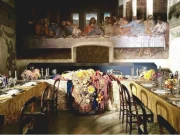
The table placed before the fresco reinforces that transformation. Lavish, symmetrically arranged, filled with flowers that overtake the space, surrounded by empty chairs waiting for bodies that are no longer there. Everything has been prepared for community, but no community remains. What remains is not a supper, but the staging of a supper, a form of togetherness without people.
At that moment, the film enters a space that can be recognized as a digital vacuum. The image itself has not disappeared. On the contrary, it becomes more precise, more controlled, more perfect. Only one element remains absent, the one thing that can no longer be simulated.
Touch.
In Leonardo’s original scene, bodies react, hands move, gazes search for one another, betrayal passes through the space like an electric current. In the reconstruction, bodies are no longer necessary. Their form alone is enough. The same logic shapes Runway in the sequel. The magazine no longer needs editors, models, or relationships. Aesthetics are enough, the image is enough, distribution is enough.
In that sense, the reconstructed Last Supper does not function as a weaker version of the original, but as its precise successor within a system that no longer distinguishes reality from its replacement. Not because it is false, but because it is convincing enough to assume the same function.
That logic materializes inside the Galleria Vittorio Emanuele II. The nineteenth-century glass-and-iron arcade, conceived as a passage linking the Duomo and La Scala, has long functioned as a Milanese salon where commerce, representation, and urban liturgy merge into a single architecture. It was precisely within that space that one of the first Prada stores opened at the beginning of the twentieth century, symbolically closing the circle between aesthetics, luxury, and distribution.
The Galleria therefore ceases to function as a passage and becomes the nave of a secular cathedral of capital.
One detail becomes crucial within that space. Christ appears without a halo.
In Western sacred painting, the halo usually functions as an immediate marker of sanctity, a visual guarantee that recognition has already been resolved in advance. Here, that guarantee disappears. Recognition becomes uncertain. Betrayal no longer emerges against a clearly marked figure of salvation, but within a space where the distinction itself has become unstable.
That is precisely why Miranda notices it. Not because she stands outside the system, but because she still recognizes the difference between presence and imitation, between creation and its replacement.
Miranda standing alone at night in the center of that structure does not function as an aesthetic effect, but as a precise ontological cut. A sovereign without a court stands beneath glass that has taken over the function of the sky, surrounded by commodity-icons that have replaced community. Her silent scream does not require a voice because the architecture already articulates it. The space is sacred in form, commercial in function, and empty in spirit.
Within that framework, the Leonardian code reveals its full weight. The Last Supper no longer functions as a reference, but as a pattern rewritten into a system where betrayal is no longer the exception, but the condition itself. The community does not collapse at the moment of revelation. It has already collapsed before the scene even begins.
Before that scene, Miranda is neither victim nor executioner in the classical sense. She becomes the face of a system that recognizes that the community of creation has dissolved into a network of calculations. In that sense, she takes on the role of a guardian of a disappearing Arcadia, not because she stands outside the system, but because she still distinguishes betrayal from innovation.
The broader context of Western iconography intensifies that choice even further. The devil usually appears either as a seductive figure imitating truth, or as a defeated grotesque crushed beneath the feet of the victor. This film chooses the first form. Its devil does not scream or deform itself. It functions within the system, speaks its language, and belongs to it perfectly.
Within that space, betrayal no longer functions as an event.
It becomes a mode of operation.
Soft Censorship, the Software Cough, and the Firewall
The intuition of the “software cough” opens almost seamlessly onto contemporary theories of digital power. Shoshana Zuboff defines surveillance capitalism as the unilateral appropriation of human experience for its transformation into behavioral data and predictive products. The key to her analysis is not exploitation alone, but the relationship she describes as a “one-way mirror.” The system sees and extracts, while the subject no longer sees what has been taken or how. In that sense, human presence does not disappear through violence, but through its decomposition into metrics that are later redistributed as market resources.
Such a framework corresponds precisely to the space the film opens. What disappears is not content, but relationship. Speech formally remains present, yet loses its force because its movement is no longer determined by communication, but by distribution.
Within that context, soft censorship no longer operates through prohibition, but through filtration. OSCE documents on artificial intelligence show how content is flagged, demonetized, deprioritized, or removed, often without clear criteria and with a high margin of error. The consequence is not open repression, but a “chilling effect,” the gradual withdrawal of speech and the intensification of self-censorship. Springer’s studies of algorithmic moderation further emphasize the phenomenon of “over-blocking,” in which the system, unable to understand context, removes even what is not problematic.
Such a mechanism no longer requires a censor in the classical sense. Reducing visibility is enough. Speech remains, but ceases to reach anyone. Within that space, the devil no longer tempts the soul through prohibition, but governs its reach.
That is why the concept of the firewall can no longer be reduced to a technical function. NIST defines it as a system that regulates traffic between networks, allowing approved flows to pass while blocking what it identifies as risky. Once that definition is translated from a technical into an ontological register, it becomes a model of relations in which not only security, but the very possibility of contact, is regulated.
The firewall presents itself as protection, yet its true function is selection. It determines what may pass, what remains outside, and what is marked as a threat. In that sense, the space it produces no longer functions as a space of conflict, but as a space of filtered touch.
Emily returns precisely at that point. Her line about burned bridges ceases to function as a figure of ambition and becomes a structure. The bridges she burns do not merely illuminate movement forward, but seal off everything that might return. What emerges is a personal firewall in which outward energy remains permitted, while incoming relationship becomes a security risk.
Such an order no longer requires open violence. It is enough to obstruct transmission. In that sense, hell is no longer a space of flames, but a space in which warmth can no longer cross the boundary.
The Filigree of Betrayal and the Craftsman’s Hand
The film suggests that betrayal is not a malfunction of the system, but its hidden motor. Creation no longer emerges from innocence, but from the burnt tissue of relationships that have already passed through rupture and substitution.
The film introduces a scandal surrounding an AI-generated image of Miranda, distributed as the product of a machine even though it was in fact created by hand. The image that appears within the narrative as an algorithmic product is grounded in the gesture of a human hand that remains outside the story itself, concealed behind its own simulation. The viewer sees the machine, but what is actually being seen is the trace of a hand that has not disappeared, but survived after being displaced beyond the frame.
Within that reversal, the logic of the system reveals itself with precision. Human creativity does not disappear, but survives by imitating the aesthetics of its own replacement. It does not oppose the system from the outside, but survives within its structure, adopting its language and its forms.
This is not deviation, but adaptation.
In that sense, betrayal and creation no longer stand on opposite sides. What once constituted a betrayal of the source now becomes the condition of continuation. Creation no longer exists without that fracture, without being translated into a form capable of passing through the system.
That is why this detail does not function as an interesting meta-trick, but as a condensed model of the world the film presents. An image that appears to be the product of a machine, yet carries the trace of a human hand, becomes the point at which the entire dynamic of substitution reveals itself.
What matters is not that it is false.
What matters is that it is convincing enough to take the place of the real.
It is there that the filigree connection between betrayal and creation becomes fully visible. The same pattern had already appeared in the reconstruction of The Last Supper. There, the original was replaced by a set. Here, the hand hides behind simulation. In both cases, what once created has been displaced beyond the frame, while its replacement takes over the visible surface of the image.
The hand survives, but its gesture no longer moves toward another hand. It moves toward a system able to simulate the presence that once emerged through touch.
The Spark in the Vacuum
Near the very end, the film offers perhaps its quietest, yet most precise cut. Andy extends her hand toward Emily, not as a gesture of reconciliation, but as a movement emerging from a space that no longer belongs to the system in which they both operate.
The gesture is not emphasized. There is no drama, no pathos. The hand does not arrive with certainty, nor as a decision, but as an attempt that remains open. It is precisely within that uncertainty that the Michelangelesque matrix begins to activate.
In Michelangelo’s Creation of Adam, in the scene of the almost-touching fingers, what matters is not the touch itself, but the gap. The fingers do not meet. Life is not given as a completed fact, but as a possibility dependent upon acceptance. “Through which the breath of life is transmitted,” but only if the movement is completed.
Emily remains within that gap. Her line has already defined the world through which she moves: “May the bridges I burn light my way.” This is no longer a metaphor for ambition, but a structure. The light guiding her no longer emerges from relationship, but from its destruction, and the ashes are no longer residue, but orientation.
That is why Andy’s hand does not function as salvation, but as a disturbance within that order. It does not belong to a system that organizes relationships through function and distribution. In that moment, there is neither rejection nor completion of the gesture. Emily does not pull away, yet she does not move toward the hand either. She remains within the gap.
This is not a decision, but a condition.
The problem is not that the system prohibits touch, but that it produces bodies no longer capable of completing it. The firewall is no longer an external mechanism, but a reflex, an automatic response of a body that has learned to filter everything that cannot be processed as function.
Emily understands what is being offered to her, but she cannot translate it into movement. Her Luciferian logic becomes visible precisely within that inability. The light she built by burning bridges no longer creates space, but closes it off and holds it within its own trajectory.
In that sense, her world is not merely isolated, but sealed.
Andy’s hand enters that sealed world as an anomaly. It does not seek exchange, imposes no condition, and cannot be translated into a functional relationship. The kinetic intelligence of that touch emerges from presence rather than purpose, and for that very reason it cannot pass through the system.
It is there that the paradox of the second part fully opens. This is not a choice between good and evil, but between two ontologies. One sustains the world through destruction, while the other reopens it through relationship. Without the preceding fire, that touch would carry no weight. Yet it is precisely that fire that creates the conditions in which touch can no longer be completed.
The film offers no answer, but it draws the cut with precision.
While Miranda stands beneath the glass vault of the cathedral of capital in the Galleria, surrounded by a perfection no longer capable of receiving relationship, Andy attempts to do something that no longer serves any function within that space. She attempts to touch another human being.
Between those two gestures, the entire film unfolds. One ends in total control without touch, while the other remains suspended within an attempt that offers no guarantee of completion. The question that remains is no longer whether touch can occur, but whether there is still a body capable of completing it.